AI home inventory for insurance · iPhone and Android
Inventory everything in your house with two photos per room.
AI reads the photos, identifies and catalogues every item with a replacement value, and builds a report you can share with your insurer.
Free for 2 rooms. Whole Home is a one-time US$49.99. No subscription, no credit card to start.
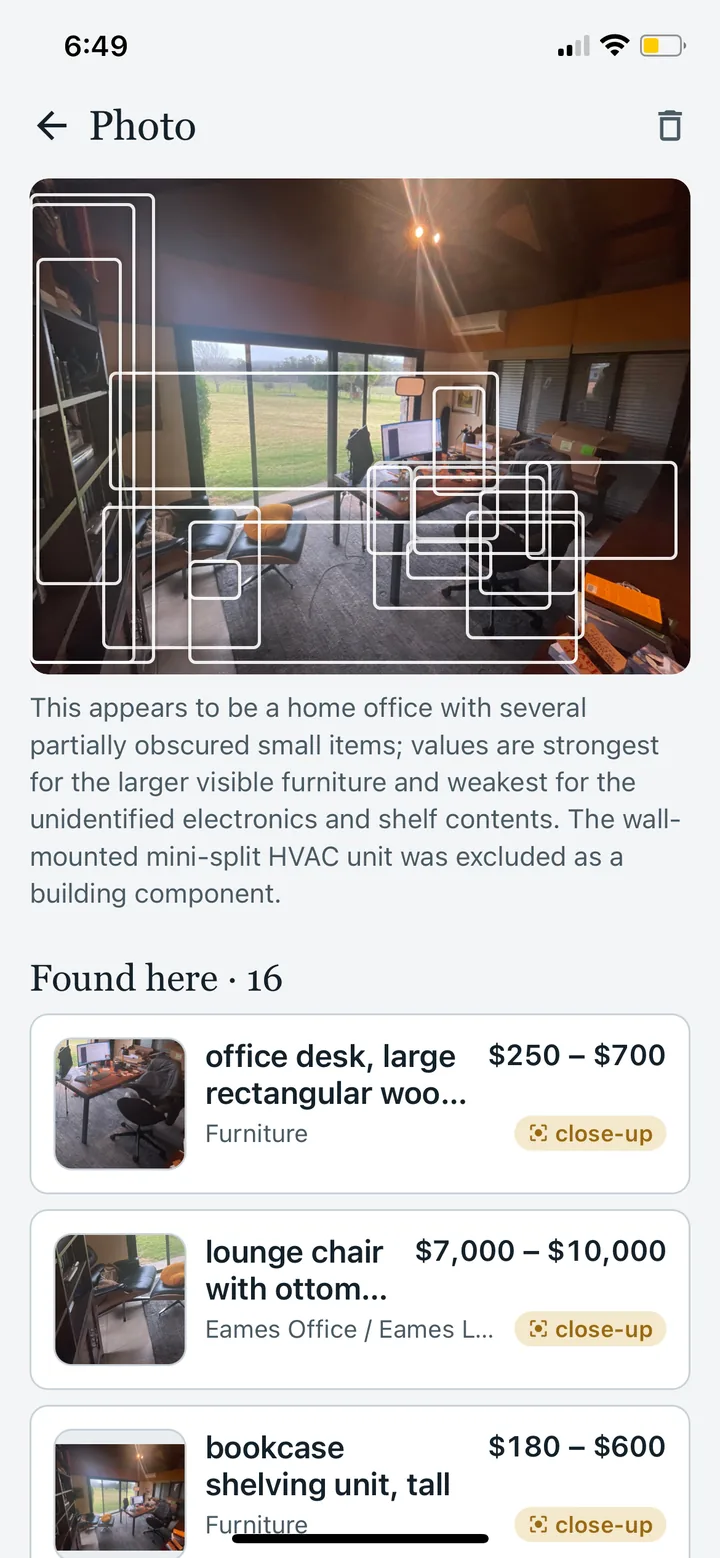
Two photos per room
Stand in the doorway, then the opposite corner. That is the whole job for most rooms. A three-bedroom house is 25 to 30 photos and about an hour.
AI identifies every item
The AI reads both photos together and catalogues each object it can see: the sofa, the TV, the rug, the lamp, the books on the shelf, each with a name, a quantity and an estimated replacement cost.
A report you can share
A PDF with photos, every item and a total to hold against your policy's contents limit, plus a spreadsheet. Send it to your insurer, your agent, or anyone who asks what you own.
The report
This is what your insurer gets.
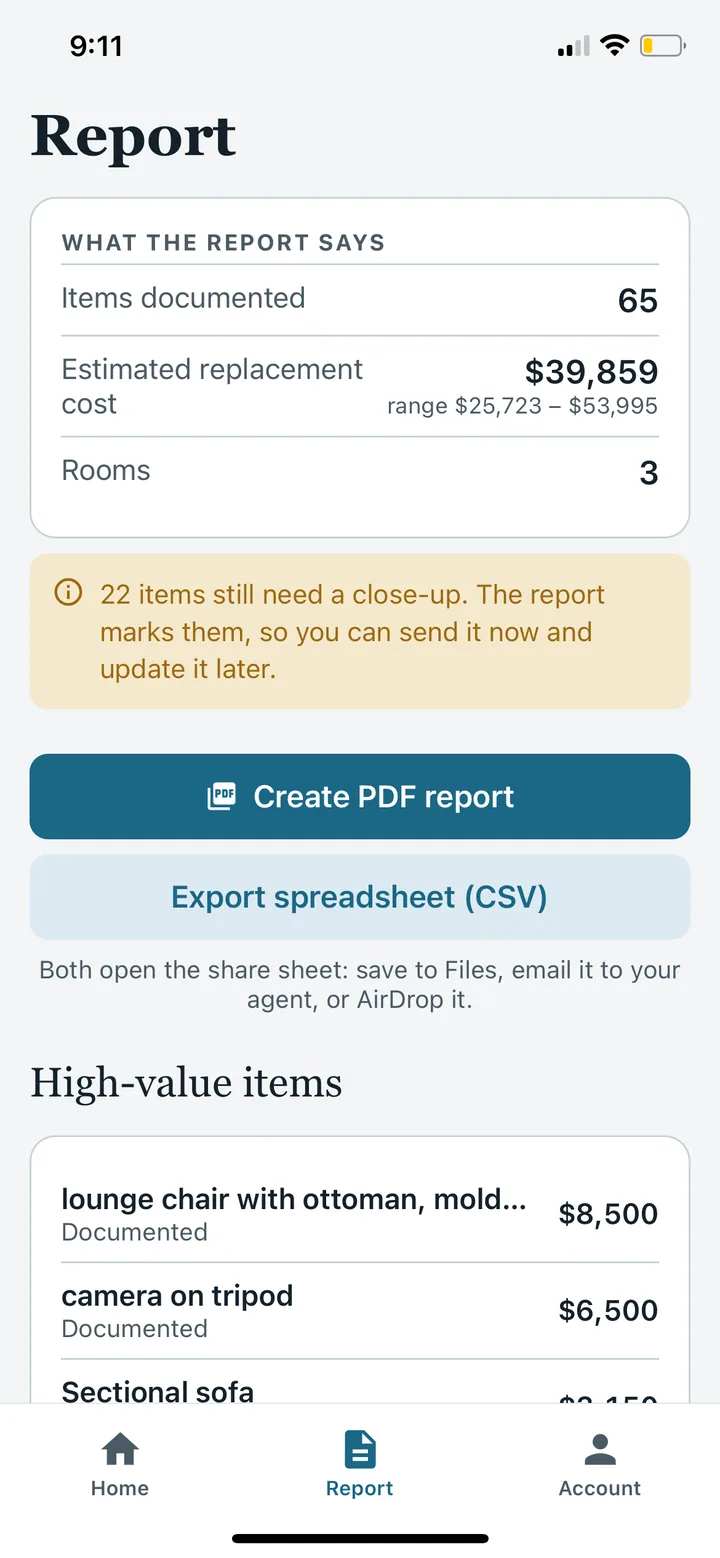
A real report from a two-room scan: 39 items, an estimated replacement cost of $33,298 with its range, a high-value schedule up front, then every room's photos followed by each item with its condition, description, brand where the AI could read it, and a replacement-cost range. Items still waiting on a close-up are marked, so you can send it today and update it next month.
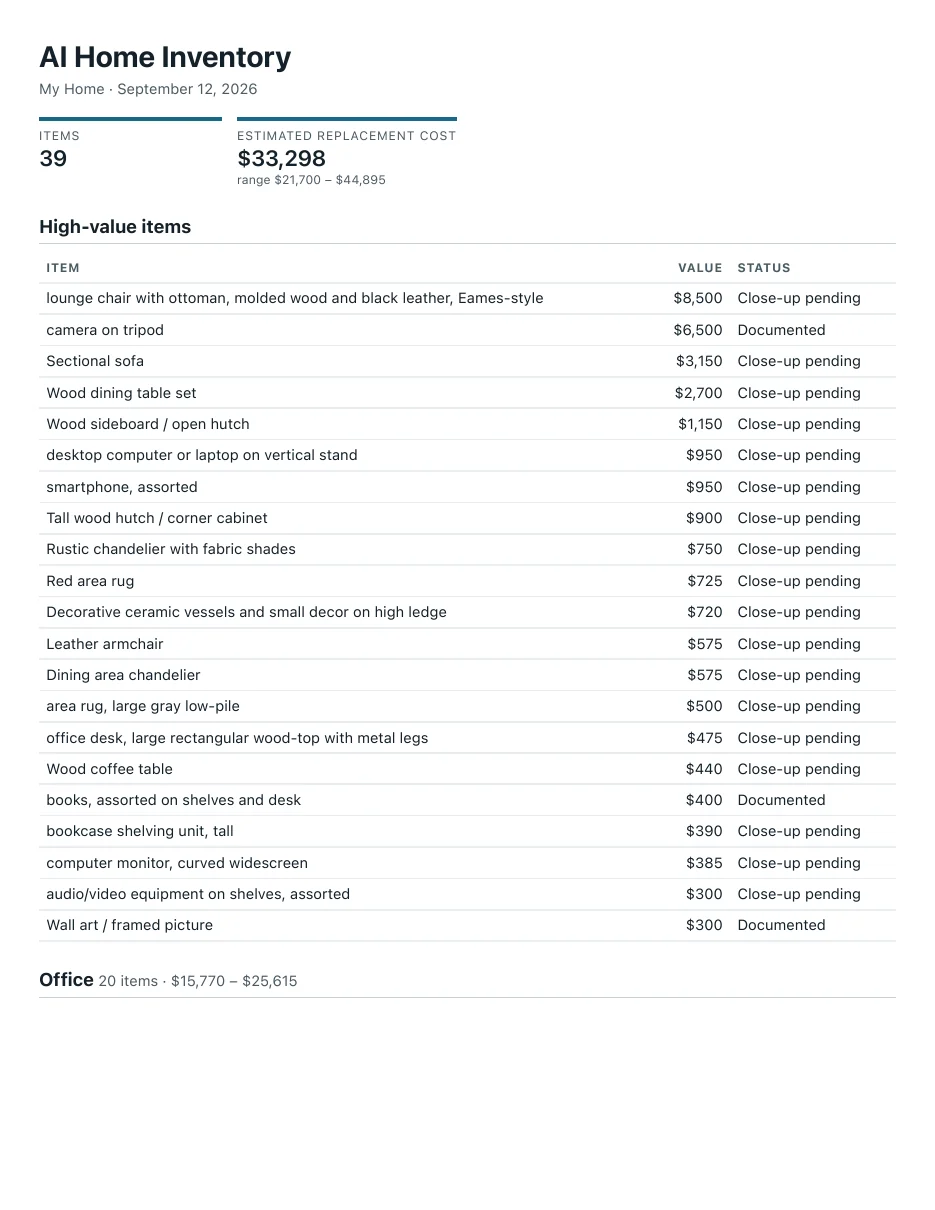
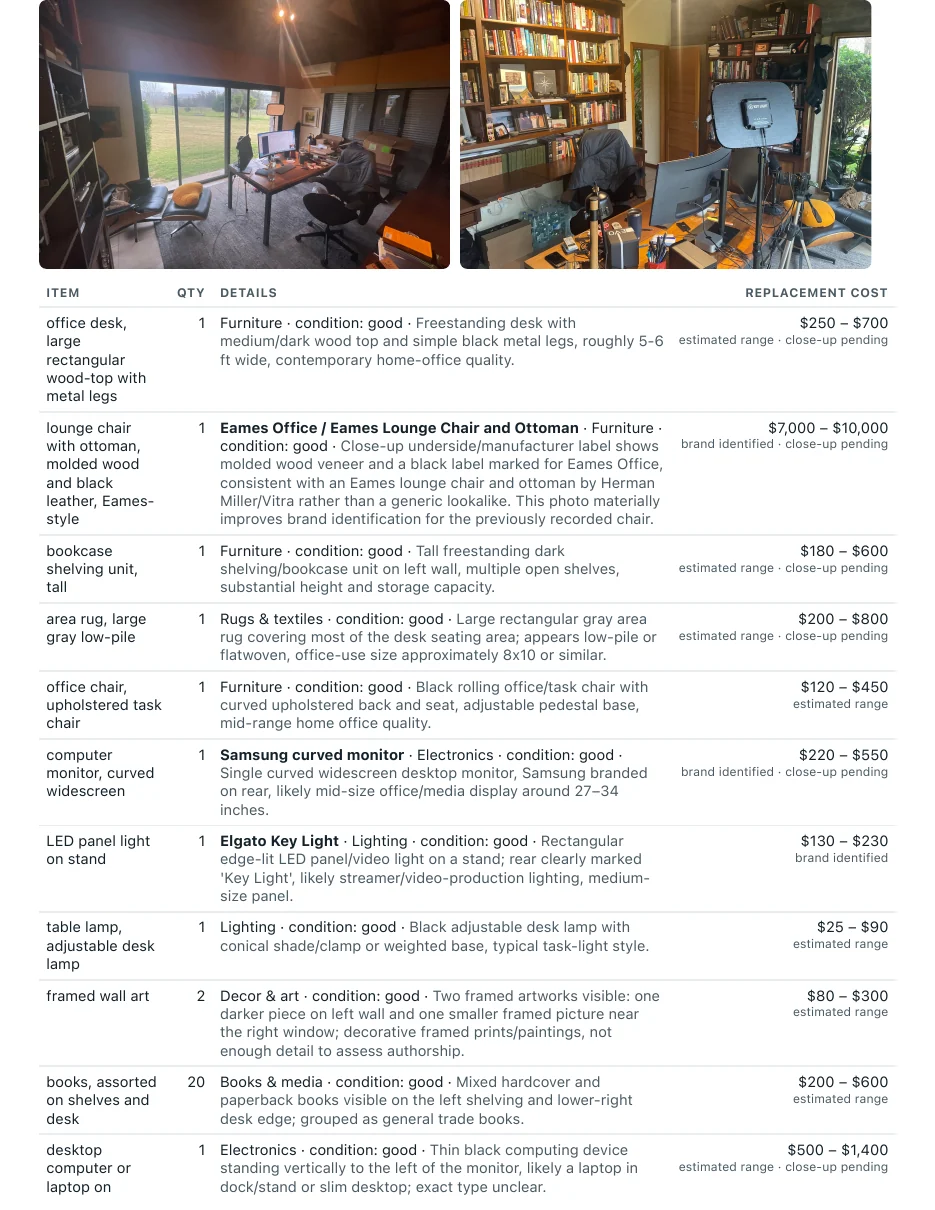
PDF and CSV are included with Whole Home. The two free rooms show you the full list and totals in the app and on the web.
How it works
Four steps, about ten minutes a room.
- 1
Photograph the room
Two shots back to back: from the doorway, then from the opposite corner. The app tells you where to stand and takes both before it lists anything.
- 2
The AI lists what it sees
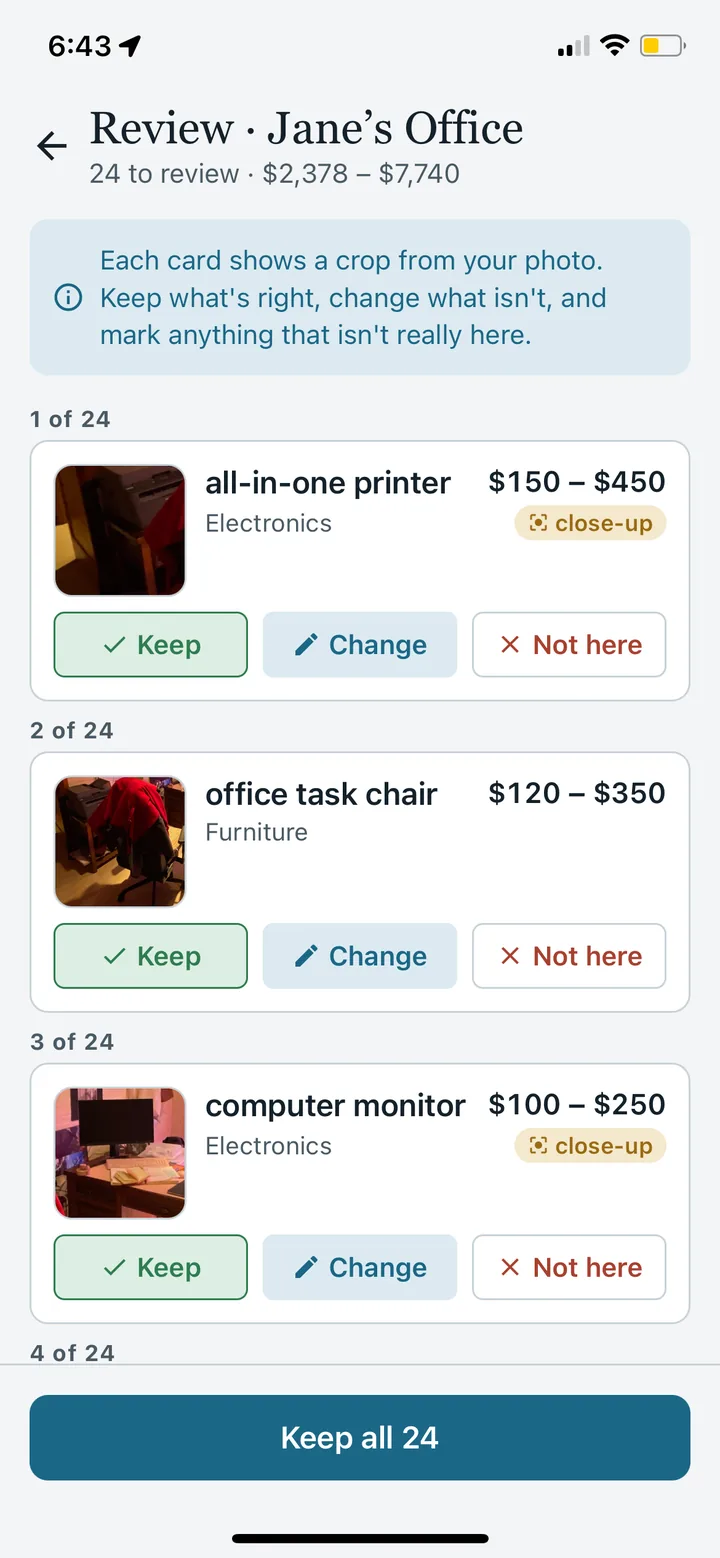
Both photos are read together and merged into one list. Each item card shows a zoomed crop of the object, a name, a quantity, and an estimated replacement-cost range.
- 3
Keep, remove, close-up
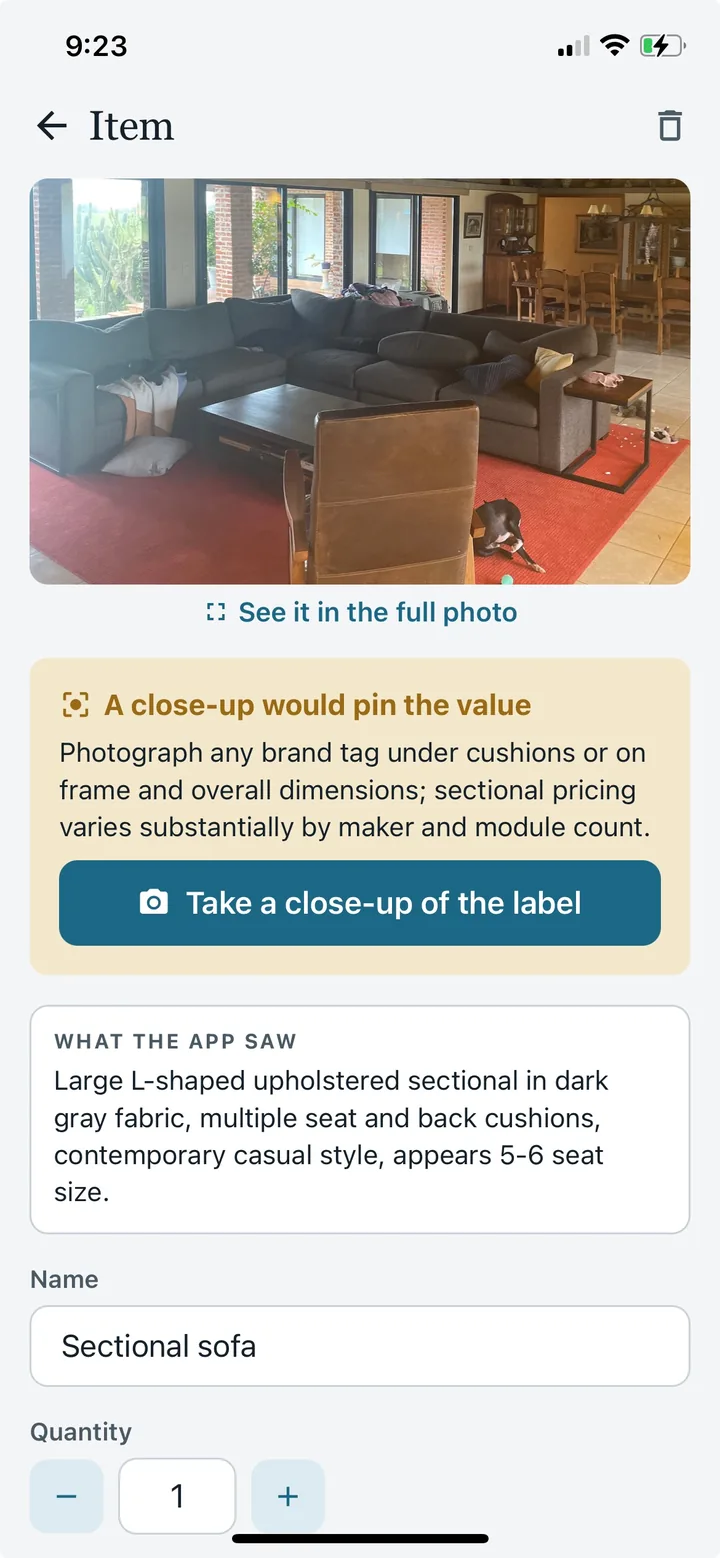
Swipe through the cards. Anything valuable or unidentifiable gets a request for a close-up of the label or receipt, which pins the value.
- 4
Get the report
A PDF with photos, every item, and a total to hold against your policy's contents limit. CSV too. Send it to your agent from the share sheet.
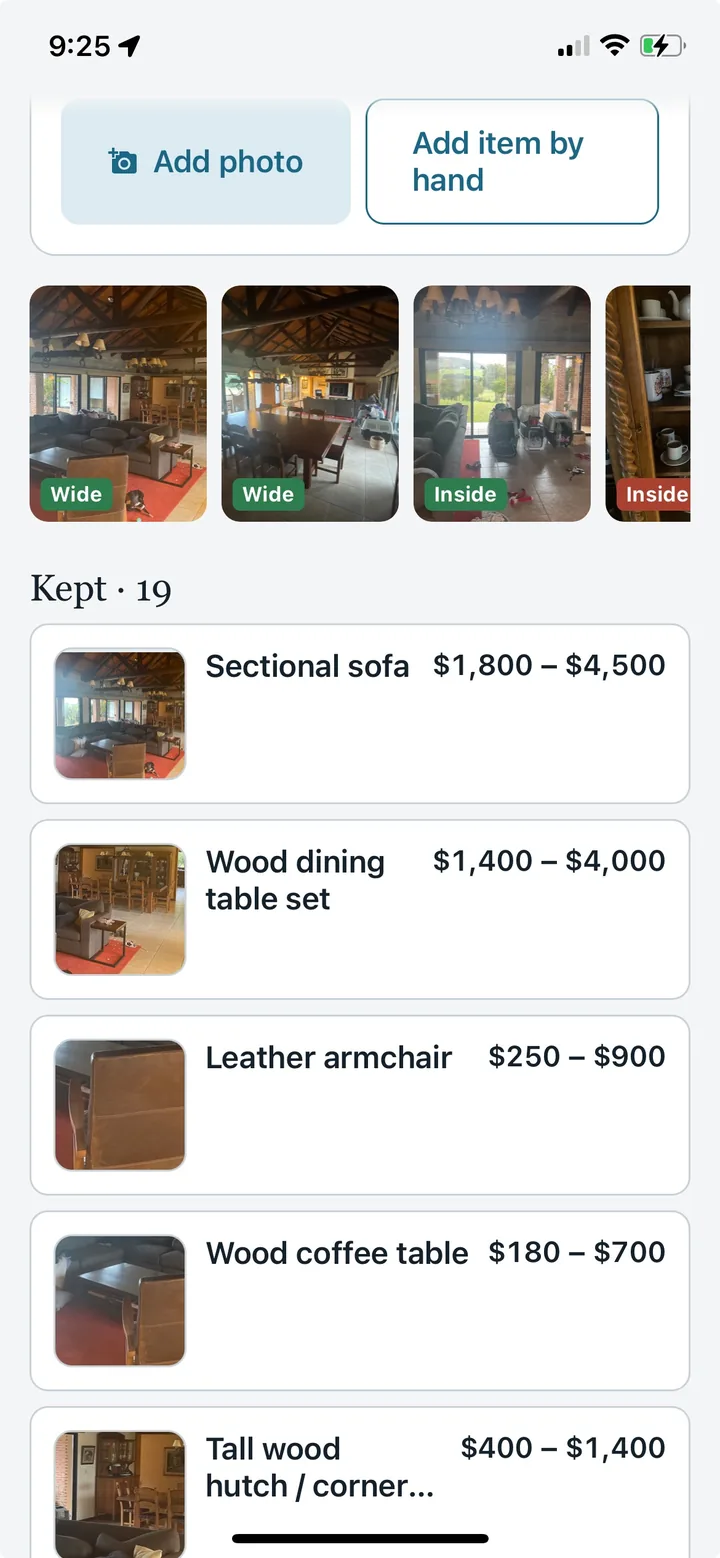
Screens
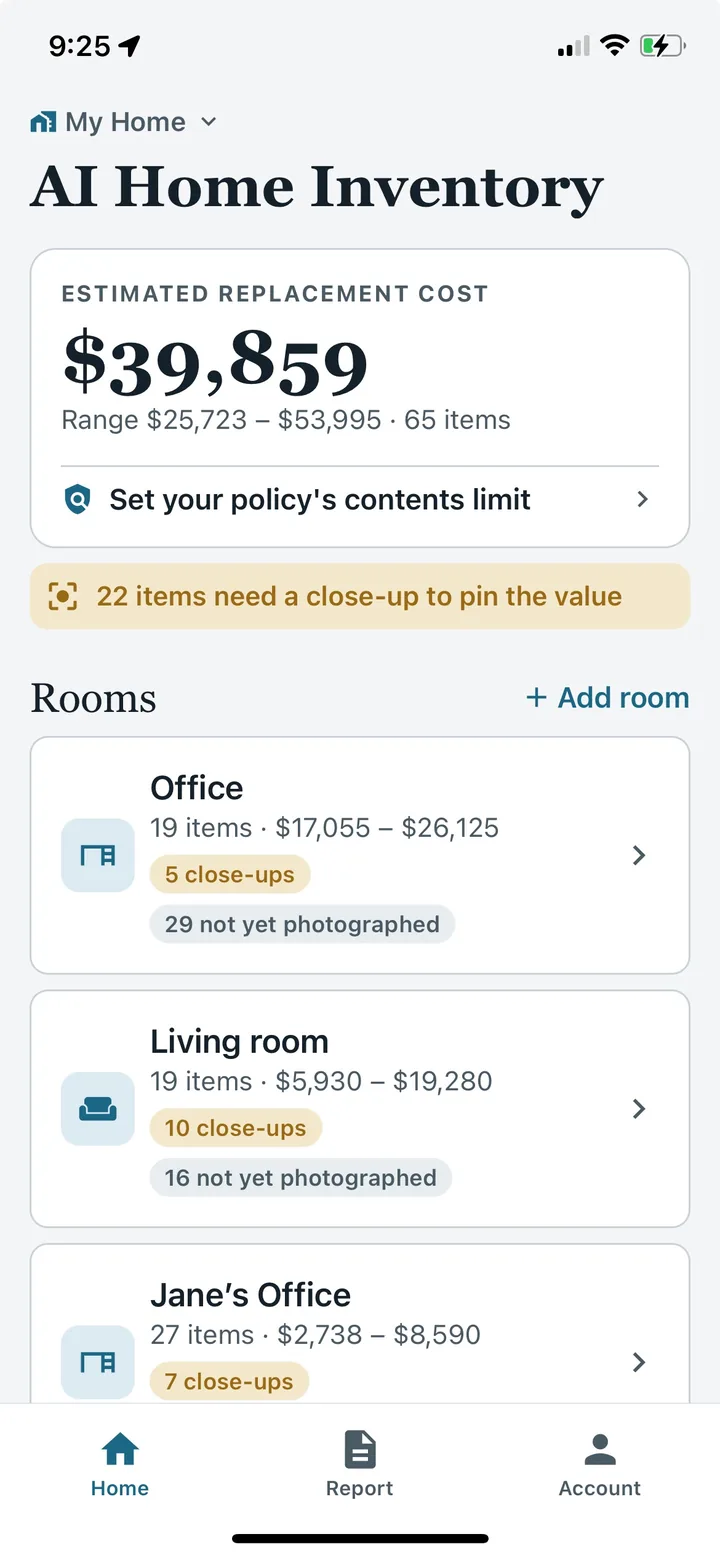
From the first photo to the finished report.
What's different
Built as an insurance document, not a catalogue.
Whole-room scanning
One photo covers the sofa, the TV, the rug, the lamp and the bookshelf at once. No item-at-a-time photography.
Replacement-cost ranges
Every item gets a low and a high for what a new equivalent costs today, plus the quality cues the estimate used, so you can correct the premise.
Coverage gaps
The app says what a shot couldn't show, such as a closed closet or the drawers in a dresser, and turns each into a suggested photo.
Close-ups that pin the value
Designer-looking furniture, electronics and instruments get flagged. A photo of the label or a receipt replaces the estimate with a real figure.
Policy limit check
Enter your contents limit, or photograph the declarations page, and the dashboard shows whether you're likely underinsured.
PDF and CSV reports
Photos, items, values and a high-value schedule in one document adjusters recognise. Spreadsheet export for your own records.
Kept off your phone
Photos and items are stored with your account, not only on the phone, because the phone is usually in the same fire as the house. Review and edit everything at aihomeinventory.co/app from any computer.
No login wall
Start photographing immediately. Add an email when you want the inventory to survive a new phone.
The values are ranges on purpose.
A photo of a room cannot tell a $400 watch from a $9,000 one, or a print from an original, and the app does not pretend it can. Visible furniture, appliances, electronics and rugs get an estimated replacement-cost range. Anything the range can't settle gets flagged for a close-up of the label or a receipt, which replaces the estimate. Jewelry, art and collectibles are never given a number; you enter the appraisal. What an adjuster needs after a loss is evidence, and the evidence is what most people don't have.
Guides
Before you start
Home inventory for insurance
What adjusters need, replacement cost versus actual cash value, and the Coverage C limit.
Room-by-room checklist
What to photograph in each room, what to record per item, and what people forget.
Renters insurance inventory
Contents-only policies make the inventory the whole claim. How to do an apartment in an hour.
Common questions
How many photos does a room need?
Two wide shots for most rooms, from the doorway and from the opposite corner, plus one shot for each opened closet, cabinet or drawer that holds anything worth documenting. A three-bedroom house is typically 25 to 30 photos.
How accurate are the estimates?
Good for what is visible: furniture, appliances, electronics, rugs, lighting. Ranges are deliberately wide, usually two to three times between low and high, and a room's total is more reliable than any single line because errors partly cancel. For premium items the wide shot is a floor, which is why the app pushes close-ups.
What about things in drawers and closets?
The app lists them as coverage gaps after each wide shot and suggests the photo to take. Open the door or drawer, shoot it, and the contents are added to the same room.
Does it work for renters?
Yes. Renters insurance is contents-only, so the inventory is the whole policy. See the renters guide.
What happens to my photos?
They are stored with your account so the inventory survives the loss of the phone, and you can review and edit everything at aihomeinventory.co/app from a computer. They are sent to an AI model to list items and are not used to train anything. Delete the account in the app and every photo goes with it.
Start with the room you're in.
Create a free account, download the app, and take your first two photos. Whole Home is US$49.99 once, with 60 AI photos, PDF reports and an off-phone copy. Listed on the App Store as “AI Home Inventory: Room Scan”.
Free for 2 rooms. No credit card, no subscription.